Our other sites:


The main reason that automatic gates are required in commercial settings is convenience and security, namely, when the site needs to be secure all day but provide instant and reliable access to staff, visitors, and customers frequently throughout the day. Security is also increased as an automatic gate system can control who has access and when. Keep reading to find out about other benefits of commercial automatic gates.
- Keep staff safe
- Add access controls
- Large gates
- Protect high value items
- Prevent trespassing
- High activity
- Increase business value
- Insurance
- Improve first impressions
- High security areas
Keep staff and vehicles safe
Automatic gates around a commercial property or business help to increase the trust that staff have in their own security as well as the security of their personal property while they are in the workplace, helping to create a more relaxed and productive environment. Commercial automatic gates may be required to keep staff and vehicles safe from theft and vandalism, especially if the risk assessment indicates a heightened threat. The need for automatic gates at commercial sites is particularly important if the site is located in a place notorious for high crime, and at sensitive sites where there is a risk of protests, such as pharmaceutical companies.
Automated gate access controls
Access can be granted for staff and visitors in a number of ways by pairing the electric gate with an access control device such as a card reader, key fob, biometric reader, intercom, or keypad. We recommend that alongside an automated vehicular gate, a pedestrian gate is included for those on foot. This increases safety and prevents unnecessarily creating a large gap in the perimeter which is a security risk. Pedestrian gates can also be automated if required.
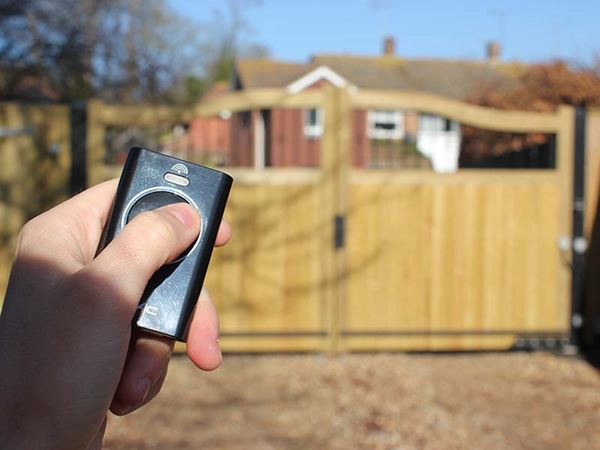
Timer clocks are also available for automatic gates, which can be set to open and close at certain times. These are ideal for business premises where there is an influx of traffic at regular times, for example between 8-9am and 5-6pm, with the gate closed for the rest of the day. They are also regularly specified for car parks and retail/industrial estates that require security at night but are open during the day for customers. With these automation controls, the timer clock needs to be included in any shut down period checklists, such as over Christmas, to ensure gates do not open at random times.
Large gates
At Jacksons, our electric gates can span up to 24 metres wide. A steel gate of this size would be extremely heavy and awkward to open and close manually, and would take a while. There would also be an increased risk of injury with the manual movement, affecting who you hire. We highly recommend that large gates are automated for convenience.
High value items in the boundary
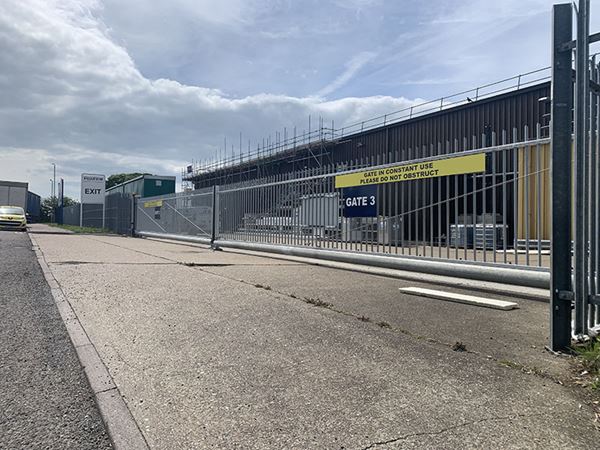
Automatic gates are recommended when the business has high value items on site. This could be vehicles, machinery, or technology. Featuring automatic locking, automated gates cannot be accidentally left open or unlocked unless programmed, and have adjustable closing speeds, so they are highly secure. When paired with an access control operator and monitored through a central control centre, entry and exit can only be granted by authorised personnel, so once gates are shut behind the vehicle entering, it would be highly difficult to make a quick getaway. In addition, an audit trail of users who have accessed the site via the automated gate can be stored. This is beneficial for high security sites in case any breaches occur and the staff on site at the time need to be questioned or CCTV footage needs to be viewed at the time someone used the access point.
Prevent people freely walking across the site
When a manual gate is left open or the front of a commercial property has no demarcation fencing, passers by may be tempted to walk across the site, perhaps to find a shortcut through or just out of curiosity. This leaves your site vulnerable to theft and other unwanted scenarios and increases the likelihood of opportunistic crime rather than planned attacks.
When there is a very active gateway
Commercial automatic gates improve convenience and security by providing remote access to authorised persons without having to employ a security guard to manually open the gate each time, which provides a significant delay particularly with large double leaf gates. Conversely, electric gates can create a delay by preventing access while checks are performed on the vehicle entering, increasing security.
To increase your business value
Installing an automated gate can increase the value of your business by ensuring any stock is kept secure to minimise loss. A good quality automated gate that is guaranteed to last for many years and has had its regular services will be an attractive prospect for a buyer should you wish to sell the site, as they have the assurance that the business has a good level of protection. Consider aesthetics when choosing an electric gate, as there are a range of designs that can enhance the appearance of your property and provide a luxury feel which may increase the value further.
Insurance
When it comes to insuring your business, an electric gate can increase security and also provides an audit trail, therefore should bring your premium down. However, be sure to purchase the gate and have it automated by an experienced and reputable supplier, as well has having the gate serviced regularly, to ensure it is safe and will not cause injury to anyone.
Improve first impressions
An impressive electric gate that works smoothly and reliability may increase the trade of your business by improving customer experience. An electric gate may also encourage visitors and clients to stay longer on site as they feel safe and know their vehicles are safe in the car park.
High security areas
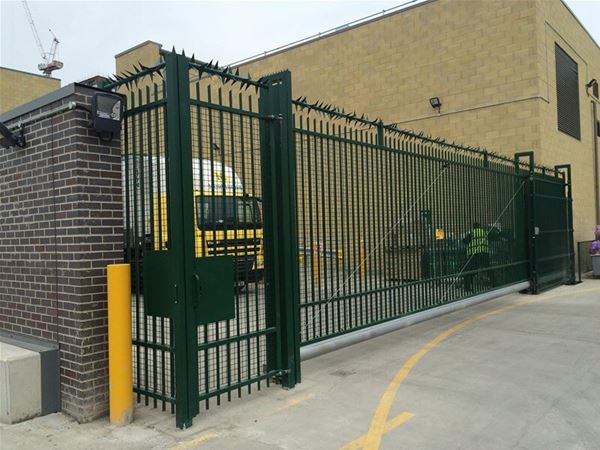
Some sites are relatively open for people to be able to enter, however, certain areas of a site may need to be more secure. For example, a supermarket. The perimeter and customer car park generally have no barriers to enter, but the delivery area at the rear will have a gate of some sort. Usually in tight spaces, electric sliding gates are ideal for this application as they do not require any space in front of them to open into.
Are commercial electric gates and automatic gates the same thing?
Automatic gates and electric gates describe the same product. If a gate is powered and opens without anyone having to touch it, you will hear it called an automatic gate, an electric gate, an automated gate or a motorised gate, and in commercial specification all four are used interchangeably. This page uses automatic and electric to mean the same thing.
What varies is not the name but the specification: how the gate moves, how wide the opening is, how many times a day it operates, who is allowed through and how that is verified, and what safety equipment is fitted. Those decisions are covered in the sections below.
We have been automating gates since 1991, our electric gates can span openings up to 24 m wide, and every one is manufactured in the UK with a 25 year service life guarantee on the gate and a 25 month guarantee on the automation.
Types of commercial electric gate
The right gate for a commercial site is usually decided by the space available at the entrance and the traffic passing through it.
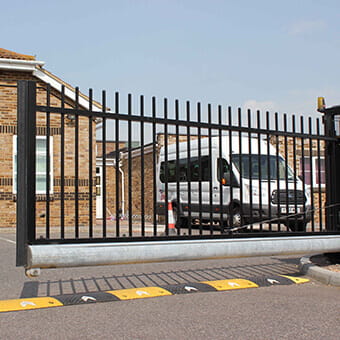
Electric sliding gates are the most widely specified commercial option. They need no space in front of or behind the gate line to swing into, which makes them the natural choice for tight entrances, delivery yards, and sites where the ground slopes upwards behind the opening. They are available as tracked or cantilever gates.
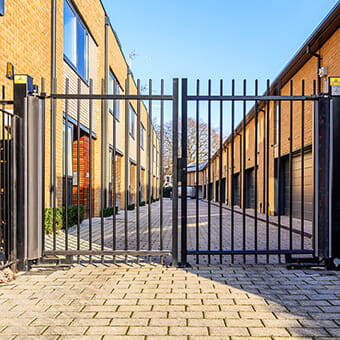
Electric swing gates suit level ground with room to open, and are often chosen where appearance at the front of a site matters. Available in single or double leaf, with a 180 degree opening tamper-proof hinge that prevents the gate being lifted off.
Cantilever sliding gates are specified where the ground is uneven or where debris would foul a ground track, since nothing crosses the opening.
Bi-folding speed gates open in a few seconds and are used where rapid, high security access is needed: data centres, ambulance stations and emergency vehicle routes.
Telescopic sliding gates span wide openings where there is not enough run-back space for a single leaf.
Traffic arm barriers and rising bollards control vehicles without closing the perimeter, which suits some sites better than a gate. Many sites use a gate for the boundary and a barrier for the car park.
Whichever you choose, we recommend a separate pedestrian gate alongside any vehicle gate, so people on foot are not routed through a moving vehicle gate and the perimeter does not need an unnecessarily wide opening.
Electric security gates by sector
Security gates for businesses are specified very differently depending on what sits behind the boundary.
Retail parks and customer car parks are generally open by day and secured at night, so timer-controlled sliding gates or traffic arm barriers with free exit tend to suit. The delivery yard at the rear is usually the higher risk, and in tight space an electric sliding gate is the practical answer.
Industrial estates and warehousing have to handle HGVs, which means wide openings, heavy duty motors rated for high operation counts, and gates that will not be damaged by constant use. Telescopic and cantilever sliding gates are common.
Offices and business parks are as much about first impressions as security. An electric gate that operates smoothly and suits the building can be paired with an intercom for visitors and ANPR for staff.
Hospitals and healthcare sites need rapid evacuation routes for emergency vehicles alongside controlled staff and visitor parking, so speed gates and barriers are often specified together.
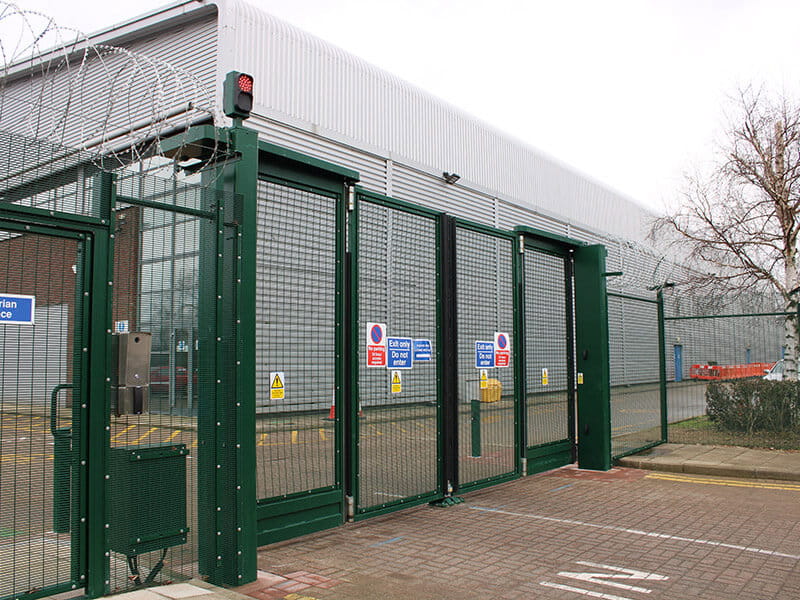
Data centres, utilities and high security sites usually specify certified gates to match a rated fence line, frequently with an air-lock arrangement and perimeter intrusion detection, with NPSA guidance setting the standard required.
We have completed projects across housing, retail, leisure, education, hospitals and healthcare, transport, utilities and high security NPSA sites, and our case studies show comparable installations by sector.
Access control for commercial electric gates
An electric gate is only as good as the system that decides who gets through it.
Gates can be paired with proximity card and fob readers, keypads, biometric readers, video or voice intercoms, ANPR cameras, remote fobs, induction loops for free exit, and timer clocks. Most commercial sites end up with a combination: an intercom or reader for visitors at the entrance, fobs or ANPR for staff, and free exit on the way out.
Timer clocks suit premises with predictable traffic (open from 8am, closed from 6pm) and are widely used on retail and industrial estates that need to be accessible by day and secure at night. They should always be added to shutdown checklists so gates do not open unexpectedly over holiday periods.
Where the gate is monitored from a control centre, entry and exit can be logged to give an audit trail of who accessed the site and when. That is valuable if a breach needs investigating, and it is often what makes the difference at insurance renewal.
Access control can also be integrated with CCTV, intruder alarms and perimeter intrusion detection systems, so the gate becomes one part of a single security strategy rather than a standalone product.
Safety, compliance and servicing for commercial gates
A commercial electric gate is machinery in law. Automated gates fall under the Supply of Machinery (Safety) Regulations 2008 and must be risk assessed, CE or UKCA marked, and supplied with a declaration of conformity. Our gates are designed and engineered to exceed BS EN 12453 and BS EN 12978 in relation to gate safety.
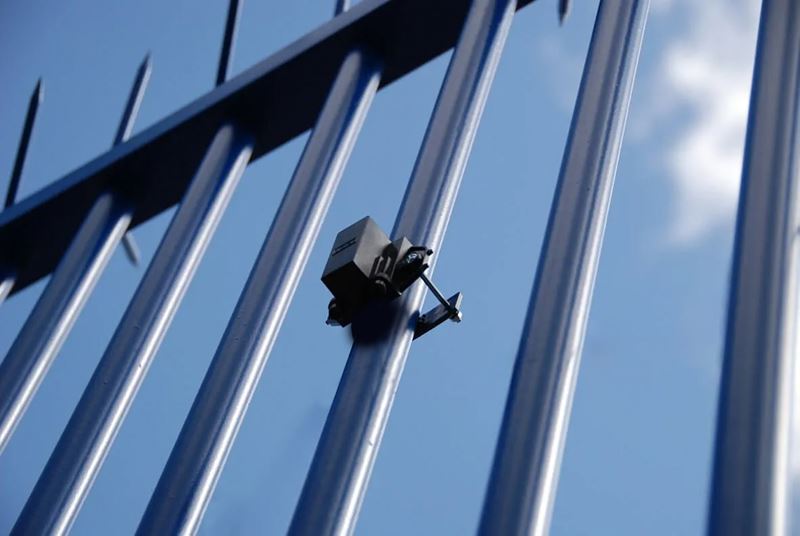
In line with Gate Safe and DHF guidance we fit a minimum of two independent safety devices to every gate, regardless of whether a force limitation device is installed. In practice that means photocells or a light curtain together with pressure edges, supported by warning signage and, where traffic volumes justify it, a flashing beacon.
Servicing matters more on commercial gates than most buyers expect. A gate operating hundreds of times a day is a machine in constant use, and a lapsed service history is both a safety liability and an insurance problem. All our gate automation engineers are DHF qualified to a minimum of level 2, and we offer service and maintenance contracts nationwide.
One point on specification: rate the motor duty against the number of operations per day you actually expect, not an average. Under-specified motors are the most common cause of premature failure on busy commercial gateways.
What a commercial electric gate costs
The width of the opening is the biggest factor. A gate spanning 4 metres and a gate spanning 20 metres are different products, and wider openings need heavier sections, larger foundations and more powerful motors.
The gate type comes next. An electric swing gate on level ground with room to open is generally the least expensive option. Tracked sliding gates cost more because of the groundworks the track requires. Cantilever gates avoid those groundworks but need a substantial foundation on the support side. Telescopic gates and bi-folding speed gates sit at the top of the range.
The infill affects both cost and lead time. Welded mesh is the most economical, vertical bar sits in the middle, and solid timber, ornamental and acoustic infills cost more, and acoustic infill adds weight, which in turn affects the motor specification.
Automation and access control can account for a significant share of the total. A single keypad is a modest addition; ANPR cameras, biometric readers, intercoms integrated with a building system, battery back-up and a full complement of safety devices add considerably more.
Spend the money on motor duty rather than saving it. A motor rated for the traffic your gateway actually sees will outlast a cheaper one several times over, and replacing a failed motor on a busy site costs far more than specifying it correctly at the outset.
Whole-life cost matters more than purchase price on a product like this. Our gates carry a 25 year service life guarantee alongside a 25 month automation guarantee, and we offer service contracts nationwide, so the cost of ownership is predictable.
We quote per project following a site survey, and quotes are free and without obligation.
This blog was originally written in 2023 and was updated in 2026.
Related products
Jacksons Security has a range of products relating to this article, all complete with our 25 year service life guarantee. If you cannot find the item you are looking for, please do not hesitate to call our friendly sales team.

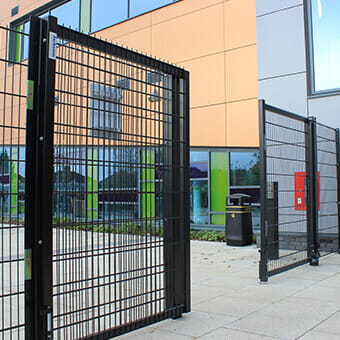
Related Content
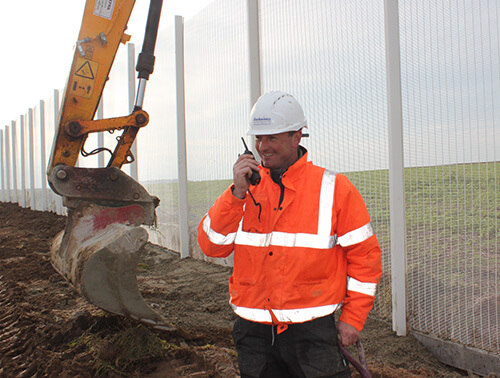
Case Studies
Related Case Studies
We have completed a large number of projects in various sectors, from housing, retail, leisure and education, to hospitals and healthcare, transport, utilities, and high security NPSA (previously CPNI) sites. Discover more through our portfolio of case studies.
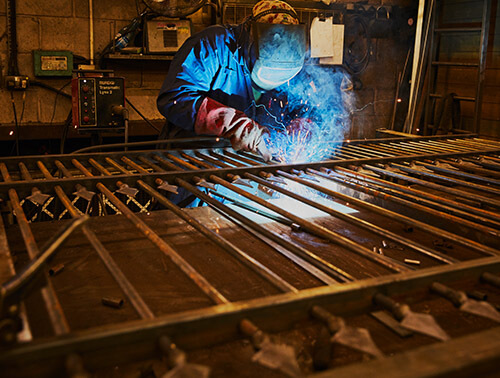
Blogs
Related Content
We have an extensive library of blogs covering a wide selection of topics, whether you need a helpful guide for recognising accreditations, an understanding of different processes such as galvanisation, or specialist advice on securing a rural site against crime.

Contact Us
Need Help?
From design and manufacturing to supply and installation, we can help you with your project. If you'd like to discuss anything in this article or need information or guidance, please feel free to contact us at any stage to discuss your requirements.
Top