Our other sites:


Car park barriers perform many functions. They slow vehicles down at the point of entry, control who can enter and exit, and often they are essential for demarcation – showing clearly where the entrance is. Car park barriers can be used in addition to, or as an alternative to gates, enabling an easier flow of vehicle access, and saving space.
Skip ahead to find out about our manual and automatic car park barriers.
In some instances, car park barriers will need to be configured with ticket, security pass and payment systems, and often the site will have specific opening hours or restricted hours for vehicles entering, but still need to allow pedestrians to pass.
There are two types of car park barriers which we explore below: Manual and automated. A key benefit of all of our barriers, is that they come with a 25 year guarantee, offering a low lifetime cost. Additionally, automated barriers have a 25 month automation guarantee.
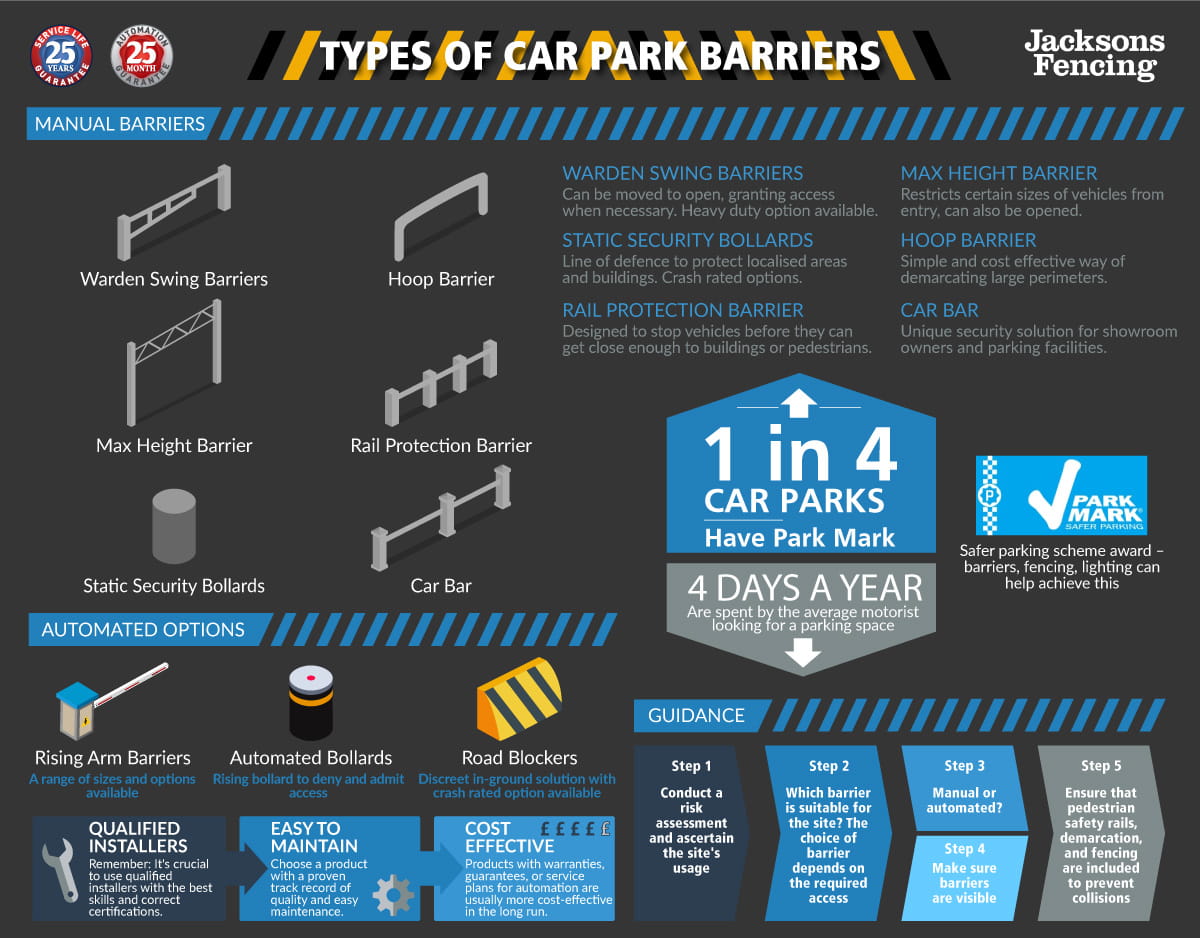
Manual car park barriers
Manual barriers are easy to install and maintain, and there are many options to choose from.
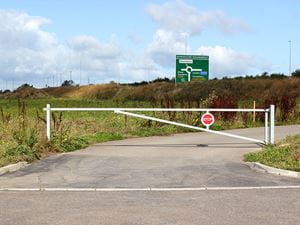
Manual warden swing barriers
Where you need some flexibility regarding access, manual warden swing barriers are a practical and cost-effective solution.
At Jacksons, our manual swing barriers or ‘warden barriers’ are constructed from 60 x 60mm Square Hollow Section (SHS) steel, with tamper-proof hinges. The barriers can be padlocked in the open or closed position.
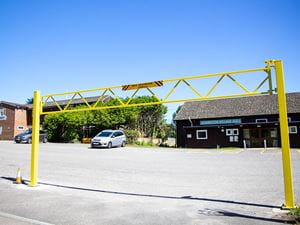
Max height barrier
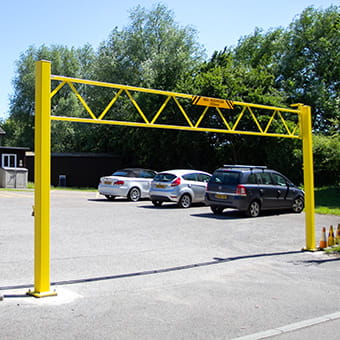
You’ll need a max height barrier or height restriction barrier, to stop unsuitable vehicles gaining access to your road or car park. If you want to exclude larger lorries and camper vans coming onto the property, these metal posts with strong horizontal bars will do the trick.
Our MaxHite height restriction barrier is designed to suit any width and height requirement and is supplied galvanised as standard, or powder coated as an optional extra. The barrier can be locked in the open and closed positions.
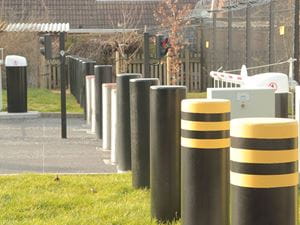
Security bollards and hoop barriers
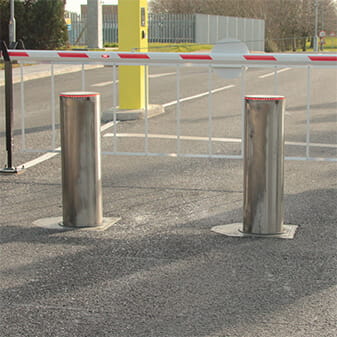
Bollards can also be used for access control around properties and grounds. Security bollards are typically used for separating vehicles and pedestrians, or for hostile vehicle mitigation. Jacksons offers many types, including automatic bollards, static, stainless steel, and timber bollards, suitable for driveways through to high security applications with anti-ram designs.
Rail protection barrier
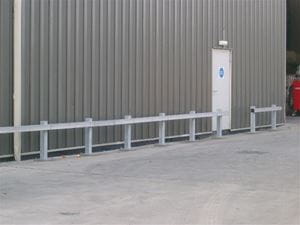
Rail protection barriers are essentially crash barriers, designed to prevent vehicles getting close enough to buildings to cause damage. These are popular in car parks where large vehicles might be reversing in close proximity to walls, or where heavy use of a car park can generally cause wear and tear to buildings. These need to be very strong. Our barriers are made from durable hot dip galvanised steel 100 x 100mm RHS.
Car bars
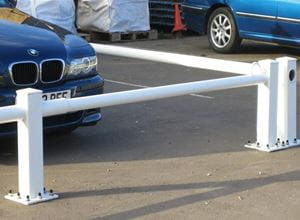
In some car park locations, it’s helpful to have ‘post and rail’ surrounds, otherwise known as car bars, rather than solid fences and walls, as these can block visibility. Our car bars provide a handy security solution for keeping car showrooms organised and secure, without blocking access for customers viewing vehicles. Our metal car bar has been specifically designed as a parking and traffic control barrier, offering security and convenience.
Fixed hoop barrier
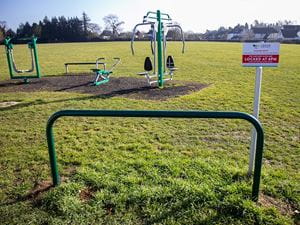
Another manual parking control, our hoop barriers are a simple way to secure large perimeters allowing pedestrian access, but making vehicular access impossible. They are popular on car forecourts but can also be used around sports grounds and to restrict access in certain areas of a country park or leisure facility. Installed in individual sections, they allow great flexibility and control over car park design and spacing between each barrier. Hoop barriers are another option for forecourts and car park boundaries, with an industrial metal construction that can be powder coated to suit your company or school colours and stand out against the background.
Automatic car park barriers
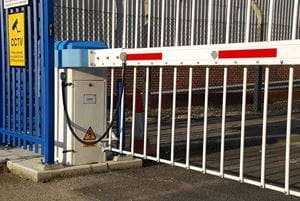
Traffic access control can be automated for convenience, in which case access control devices are needed alongside physical car park barriers to complete the application. Jacksons has a wide range of automated barriers to choose from, and vast experience in this area of security management.
Rising arm barrier
If you require an automated rising arm barrier, hawse have a complete range. It’s a case of matching the size to your specific site and being aware of how many operations per hour and per day you’ll require. We can supply traffic and car park barriers with boom lengths of up to 12.0m in medium duty.
We also stock heavy duty versions to cover a multitude of traffic control applications and offer a PAS 68 Arm barrier. For restricted headroom applications, we can supply articulated arms.
Automated bollards
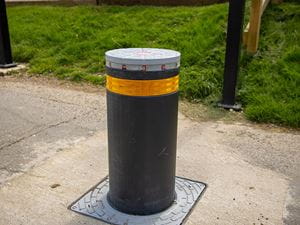
Automatic rising bollards, sometimes known as hydraulic bollards, provide fantastic security for vehicles with the added benefit that they can be retracted, when no barrier is needed. This means the aesthetics of the site can be protected, which is why these are popular at historic sites or locations where views of the landscape are valued, for instance.
Automatic rising bollards can be activated by any access control system or remote control, and are an alternative solution to static bollards. They provide an ideal way to build flexibility into your car park security measures. The Beaufort automatic bollard has fully integrated hydraulic technology and can handle heavy usage, making it popular for both private residences and busy commercial properties.
Retractable, concealed bollards are ideal for regulation of traffic into certain zones with high vehicle flow such as restricted areas, pedestrian areas, parking, and industrial sites. Long lasting and reliable, these automatic bollards are manufactured to high standards. They’re available with a diameter of 275mm, and a height of 600mm or 800mm.
Road blockers
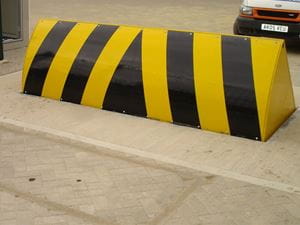
Another consideration is in-ground road blockers. These are designed for heavy duty use in car parks and entrances to provide additional security in conjunction with gates, traffic barriers or as a high security barrier. These can be installed with voice or video intercom access, or can be configured to work with access keypads, proximity cards or remote control fobs.
All our road blockers are tested to the highest standards and each variation and style is specifically designed to protect premises from moving vehicles and would be intruders.
Car park barriers for public sector and local authority sites
Public sector car parks are held to a higher standard than most, and the questions asked at specification stage are usually about evidence rather than product. Local authorities, NHS trusts, schools, and government estates need to show that a barrier has been risk assessed, that it is CE or UKCA marked and supplied with a declaration of conformity, and that whoever installed it was competent to do so.
An automatic barrier is machinery in law, so it falls under the Supply of Machinery (Safety) Regulations 2008 in the same way an automated gate does. Where a site is being protected against vehicle-borne threat, impact tested products such as our PAS 68 arm barrier and crash rated bollards will be specified instead of, or alongside, a standard rising arm barrier, and NPSA (previously CPNI) guidance will usually set the rating required.
We manufacture in the UK, guarantee the barrier for 25 years and the automation for 25 months, and all our gate automation engineers are DHF qualified to a minimum of level 2. Specification sheets, drawings, and declarations are available for every product, which is normally exactly what a public sector specifier needs in order to sign a barrier off.
How do car park barriers work?
A car park barrier works by combining three things: a physical barrier, a means of detecting a vehicle, and a control system that decides whether to let it through.
On a manual barrier, that decision is made by a person. A warden swing barrier or MaxHite height restriction barrier is unlocked, moved by hand, and padlocked in the open or closed position.
An automatic barrier replaces that step with an access control device and a motor. A vehicle arrives and is detected, usually by an induction loop set into the road surface, or by radar, a push button, an intercom, or an ANPR camera. If the driver is authorised, the control panel signals the motor and the boom rises, typically in two to six seconds depending on duty rating and boom length. The barrier holds open while a safety loop confirms the vehicle has cleared, then lowers automatically. A second loop on the exit side allows free exit without a further credential.
Because the barrier is machinery, it must fail safe. Our barriers can be released manually in the event of a power cut, and can be specified with battery back-up where continuous operation matters.
Car park barrier heights, spans, and specifications
Getting the dimensions right at specification stage saves the most time later. These are the practical limits of each barrier type.
Warden swing barriers are built from 60 x 60mm square hollow section steel with tamper-proof hinges, and can be padlocked in the open or closed position.
Height restriction barriers span roads up to 10m wide and are made to suit the height you need. Most sites specify between 2.0m and 2.5m, which excludes vans, lorries, and camper vans while letting cars through freely. Our MaxHite barrier is supplied galvanised as standard, with powder coating as an option, and is padlockable in both positions.
Rising arm barriers are available with boom lengths up to 12m in medium duty spec. Heavy duty and PAS 68 rated versions are available, along with articulated arms for restricted headroom, LED red and green boom lights, and bottom skirts up to 4m.
Rail protection barriers are made from 100 x 100mm rectangular hollow section hot dip galvanised steel, designed to keep vehicles far enough from a building to prevent impact damage.
Automatic rising bollards are 275mm in diameter and stand 600mm or 800mm above ground, retracting fully so sightlines are preserved when no barrier is needed.
Every barrier carries our 25 year service life guarantee, and automated products carry an additional 25 month automation guarantee.
Car park barrier safety and compliance
An automatic car park barrier is machinery in law. Like automated gates, rising arm barriers fall under the Supply of Machinery (Safety) Regulations 2008, and must be risk assessed, CE or UKCA marked and supplied with a declaration of conformity.
In line with DHF and Gate Safe guidance we recommend a minimum of two independent safety devices on every barrier, regardless of whether force limitation is fitted. In practice that usually means photocells or a light curtain together with a safety loop, supported by warning signage and, where traffic volumes justify it, a flashing beacon and LED boom lights.
For public sector and local authority sites there is an additional expectation that the installer is competent and demonstrably so. All Jacksons gate automation engineers are DHF qualified to a minimum of level 2, and every barrier we install is commissioned with a full risk assessment and handover pack.
Car park entry systems, exit lanes and access control
Most car parks need more than a barrier. They need to know who is coming in, when, and on what basis.
Entry and exit can be configured as a single controlled lane, as separate entry and exit lanes with free exit, or as a full ticket and payment installation for pay-on-foot and pay-on-exit sites. The barrier itself is the same; what changes is the control equipment in front of it.
Barriers can be paired with card and fob readers, keypads, biometric readers, video or voice intercoms, ANPR cameras, remote fobs, and timer clocks. Timer clocks suit retail and industrial estates that need to be open to customers by day and secure at night, though they should always be added to shutdown checklists so gates and barriers do not open unexpectedly over holiday periods.
Where pedestrians share the entrance, they should be separated from vehicles rather than routed through the same opening. Turnstiles and dedicated pedestrian gates keep foot traffic away from moving vehicles and avoid leaving an unnecessarily wide gap in the perimeter.
Installing car park barriers
What installation involves depends on the product. Manual barriers need little more than accurately set foundations and can usually be installed in a day. Rising arm barriers and automatic bollards need a foundation, a power supply and ducting for detection loops and access control cabling. In-ground road blockers need a drained chamber, so they are best planned alongside resurfacing work rather than retrofitted later.
We design, manufacture, supply, and install nationwide, and our engineers are DHF qualified to a minimum of level 2, so the barrier, the automation, and the commissioning all come from a single supplier. Every automated installation is handed over with a risk assessment, a declaration of conformity and a recommended maintenance schedule.
We have installed car park barriers across the UK, from retail parks and industrial estates to hospitals, schools, transport hubs, and high security sites. If you are looking for a barrier in a particular town or region, our case studies show comparable projects nearby and our sales team can advise on availability and lead times.
Do you need a car park barrier or a gate?
A barrier controls vehicles without closing the boundary. The arm rises, the vehicle passes, the arm falls, and the opening itself stays open. That makes barriers ideal at car park entrances where flow matters, where space is tight, and where pedestrians need to pass alongside.
A gate closes the perimeter. If the car park needs to be genuinely secure when unattended, or forms part of a fenced boundary, a gate is the right answer, and on a tight entrance an automatic sliding gate will do it without needing space to swing into.
In practice many sites use both: a gate on the perimeter to secure the site out of hours, and a barrier inside it to manage the car park during the day. Where the threat includes vehicle-borne attack, road blockers and PAS 68 rated bollards can be added at the same point.
Height restriction barriers sit slightly apart from this decision. They do not stop vehicles entering, they stop the wrong vehicles entering, and they are usually installed alongside a barrier or gate rather than instead of one.
For guidance on any of our car park barriers or any other products, contact us today.
Related Products
Jacksons Fencing have a large range of related products, all complete with our 25 year guarantee. If you cannot find the item you are looking for, please do not hesitate to call our friendly sales team.
Related Content
Case Studies
Related Case Studies
We have completed a large number of projects in various sectors, from housing, retail, leisure and education, to hospitals and healthcare, transport, utilities, and high security NPSA (previously CPNI) sites. Discover more through our portfolio of case studies.
Blogs
Related Content
We have an extensive library of blogs covering a wide selection of topics, whether you need a helpful guide for recognising accreditations, an understanding of different processes such as galvanisation, or specialist advice on securing a rural site against crime.

Contact Us
Need Help?
From design and manufacturing to supply and installation, we can help you with your project. If you'd like to discuss anything in this article or need information or guidance, please feel free to contact us at any stage to discuss your requirements.
Top