Our other sites:


Sliding gates are a popular choice when an automatic gate is considered, especially on sites where there is limited space for swing gates to operate freely and where higher security is required. Often, sliding gates form one part of an integrated perimeter system that includes fencing and other security features such as access control and electronic surveillance.
There is a growing preference for automated gates, chosen for their efficiency and ease of handling as well as their versatility: today, electric sliding gates are widely specified for residential, education, transport, military, commercial, warehousing, public utility and high-risk sites.
Specifying sliding gates is a multifaceted process and specifiers need to consider the characteristics of the two most common types of sliding gate: tracked and cantilever.
The features and benefits of tracked sliding gates
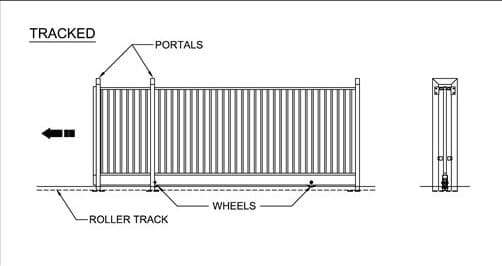
Tracked sliding gates run along a fixed track, upon which the majority of the gate’s weight is carried on wheels. The track is installed along the opening, running at the base of the gate, and the gate itself typically features automated operation. Tracked sliding gates can be of single, paired-leaf or telescopic design.
1. Space efficient
A key benefit of tracked sliding gates is that they are space-efficient and suitable for sites where there is restricted space beyond the gate. They are suitable for high and heavy gate designs and can span very wide openings. They can have a lower profile from the ground too.
2. Robust design
Tracked sliding gates provide strong security as they are difficult to force open and the few vulnerable points of their structure are hard to access. Due to their robust design, they are extremely reliable in adverse weather conditions, including high wind.
3. More maintenance
Tracked sliding gates are mechanically simpler than cantilever sliding gates, however, specifiers should take into account that tracked sliding gates require a higher level of maintenance. In order for the gate to work as well as it should, the track needs to be well maintained, regularly cleaned and clear from debris. They are also unsuitable for sites with uneven ground.
The features and benefits of cantilever sliding gates
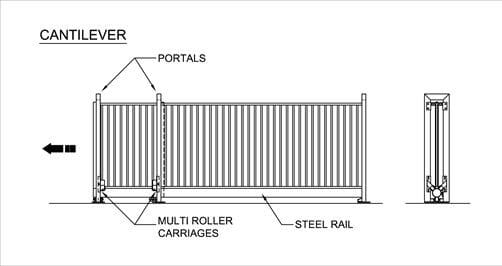
A cantilever sliding gate design is counterbalanced and therefore does not require a track to run along the opening. This type of gate is supported on post-mounted rollers that slide in a tubular track fitted to the bottom of the gate. Guide rollers at the top also enable movement of the gate. This gate design can be of single- or paired-leaf design to span. Small cantilever gates are available for pedestrian access where vehicular entry isn’t required.
1. Ideal for uneven ground
Due to the absence of a track in the ground, cantilever gates are ideal for locations where the gates span uneven ground, or where the ground slopes upwards behind the gate opening. In terms of space efficiency, a disadvantage to cantilever sliding gates is that the overall length of the gate will be greater than the gap it would span on your site; this allows for the counterbalance on the trailing end of the gate.
2. Quicker to install
These gates require less time to install, since no groundwork is required for laying a track.
3. Less maintenance
They also demand lighter maintenance as there is no need to keep the area beneath the gate clear of debris. Cantilever gates tend to be less expensive than tracked sliding gates and they have a quieter operation.
Sliding gate details, dimensions and specifications
A sliding gate is described by four dimensions. The clear opening is the gap the gate has to span. The leaf length is the gate itself, which on a cantilever gate is longer than the opening because of the counterbalance tail. The run-back is the space behind the opening that the leaf travels into. And the height is measured to the top of the infill, which should match the fence line either side.
The dimension that catches people out is the run-back. A tracked gate needs a run-back at least as long as the clear opening. A cantilever gate needs more again, because the counterbalance tail adds roughly a third to the overall leaf length, so the total length of the gate will always exceed the gap it spans. Getting this onto the site plan early avoids the most common redesign on sliding gate projects.
Beyond the leaf itself, a full specification covers the post or portal positions and their foundation sizes, the track position and depth on a tracked gate, the position of the support and guide rollers, the infill type, and the location of the motor, the safety devices and the access control equipment.
We manufacture both steel and timber sliding gates in almost every style and infill: welded mesh, vertical bar, ornamental, solid timber tongue and groove, and acoustic. Our technical team can provide project-specific detail for tender and construction packages.
How a sliding gate mechanism works, part by part
Whichever type you specify, a sliding gate works on the same principle: the leaf is supported so that it can travel horizontally across the opening, and something drives it there and back.
On a tracked gate the weight of the leaf is carried on wheels running along a track set into the ground across the opening. Guide rollers at the top keep the leaf upright and stop it twisting. Because the load is carried directly on the ground, a tracked gate can be very tall, very heavy and very wide.
On a cantilever gate there is no track across the opening at all. The leaf is counterbalanced and supported on post-mounted rollers that sit in a tubular track fixed along the bottom of the gate itself, with guide rollers at the top. The gate effectively hovers over the opening, carried entirely from one side.
Automation works the same way for both. A motor with a rack and pinion drive, or a chain or toothed belt on larger gates, moves the leaf. Limit switches or encoders tell the control panel where the gate is and when to stop. Safety devices, photocells or a light curtain together with pressure edges, stop or reverse the gate if anything is in its path. An access control device tells the panel when to open: a card or fob reader, keypad, intercom, ANPR camera, remote fob or timer clock.
Opening speed is a specification decision. A standard commercial sliding gate takes roughly 10 to 20 seconds to open, depending on width and motor duty. Where genuinely rapid access is needed, a bi-folding speed gate is usually a better answer than a faster sliding gate.
Installing a sliding gate
Installation is where the two types differ most, and it is usually the deciding factor.
A tracked sliding gate needs a level, load-bearing run across the opening and along the run-back to carry the track, which in most cases means a reinforced concrete strip. That takes time and it has to be right, because the track sets the gate's alignment for the rest of its life. Drainage matters too, since the track has to be kept clear of debris, standing water and ice in order to run properly.
A cantilever sliding gate needs no track across the opening, so there are no groundworks along the gate line. What it needs instead is a substantial foundation on the support side to carry the whole cantilevered load. Installation is quicker, and the gate can span uneven ground or an opening where the ground slopes upwards behind the gate, situations where a tracked gate will not work at all.
Both need a power supply, ducting for access control and safety device cabling, and a commissioning visit. All our gate automation engineers are DHF qualified to a minimum of level 2, and every automated gate is handed over with a risk assessment, a declaration of conformity and a recommended maintenance schedule. We have been automating gates since 1991 and install nationwide.
Sliding gate sizes, spans and opening times
How wide, how tall and how fast: those are the questions that decide the specification.
On width, our electric gates span openings up to 24 metres. Where a single leaf is impractical, a paired-leaf gate meeting in the middle halves the run-back needed. A telescopic gate, with two or three leaves travelling together, spans a wide opening from a short run-back. Tracked gates handle the widest and heaviest openings, because the load sits on the ground rather than being cantilevered from one side.
Height is more straightforward. Gates are normally made to match the fence line either side, so the gate does not become the low point in the perimeter. Both tracked and cantilever gates are available at the heights we manufacture our fencing to, including the high security ranges.
Speed is where expectations and reality tend to part company. A standard commercial sliding gate takes roughly 10 to 20 seconds to open, depending on width and motor duty, which suits most sites perfectly well. Where access genuinely needs to be faster, such as ambulance stations, data centres and emergency vehicle routes, a bi-folding speed gate is the right product rather than a faster sliding gate.
Then there is duty rating. Specify the motor against the number of operations per day you actually expect, not an average. A gate on a busy distribution yard may cycle several hundred times a day, and an under-specified motor is the most common cause of premature failure.
One last point, on weight and wind. Sliding gates carry their load on rollers rather than hinges, so they cope better with tall, solid infills and with exposed sites than swing gates of the same size.
Manual sliding gates, roller gates and other names for them
Sliding gates do not have to be automated. On an entrance used only a few times a day, or where there is no power at the gate line, a manual sliding gate is simpler, cheaper and needs less maintenance. Both tracked and cantilever gates are available in manual form, in single or paired-leaf configuration, and small manual cantilever gates are available for pedestrian access where vehicles do not need to pass. A manual gate can be automated later, provided the leaf and posts were specified with that in mind, so tell us at the outset if automation is a possibility.
You may also see sliding gates described as roller gates or rolling gates. These are the same thing: a gate that opens by travelling horizontally rather than swinging, with the name usually taken from the rollers that carry or guide the leaf. Electric rolling gate, motorised sliding gate and automatic sliding gate all describe an automated version of the same product.
Sliding security gates for higher risk sites
Where a gate forms part of a security perimeter rather than simply an access point, the specification changes.
Sliding gates are often preferred on higher security sites because their structure has few accessible vulnerable points, they are difficult to force open, and they perform better than swing gates under wind loading. The infill should match the fence line so the gate does not become the weakest part of the perimeter: welded mesh, vertical bar, solid timber tongue and groove, ornamental and acoustic infills are all available in sliding format, in steel or timber.
For higher risk sites, sliding gates can be specified to match certified fence lines, paired with our tested Trident® range, or used in an air-lock arrangement (also known as a tiger trap or sally port), where a vehicle is held between two closed points while it is checked. Where rapid access is the priority, such as ambulance stations, data centres and emergency vehicle routes, a bi-folding speed gate is usually specified instead.
All our security gates are supplied with a key lock as standard, and carry a 25 year service life guarantee alongside a 25 month automation guarantee.
For more guidance on specifying automatic gates and which type best suits your site, check out our blog post on the types of electric gates available.
This blog was originally written in 2019 and was updated in 2026.
Related Products
Jacksons Fencing have a large range of related products, all complete with our 25 year guarantee. If you cannot find the item you are looking for, please do not hesitate to call our friendly sales team.

Related Content
Case Studies
Related Case Studies
We have completed a large number of projects in various sectors, from housing, retail, leisure and education, to hospitals and healthcare, transport, utilities, and high security NPSA (previously CPNI) sites. Discover more through our portfolio of case studies.
Blogs
Related Content
We have an extensive library of blogs covering a wide selection of topics, whether you need a helpful guide for recognising accreditations, an understanding of different processes such as galvanisation, or specialist advice on securing a rural site against crime.

Contact Us
Need Help?
From design and manufacturing to supply and installation, we can help you with your project. If you'd like to discuss anything in this article or need information or guidance, please feel free to contact us at any stage to discuss your requirements.
Top